
James Warner Poetry
Poetry and Tradition
What is poetry, and what can it offer us? Even readers who have encountered a good deal of it may wonder. There are shiny newer things in the world, clamouring for attention.
A long time ago, a teacher gave me some direction. (Though much was communicated through his silent presence, somehow I did find questions to ask.) In discussing the art of poetry, ‘clarity’ was the key value I got out of him. Then, after a pause: ‘and a certain beauty of expression.’ I waited for more. ‘A work of art needs to be built up in some way. But not too much.’
I was under the impression that spiritual poetry was likely to be about something spiritual. ‘A real poet can write about anything,’ he said.
He wouldn’t let me complicate it. In time, I came to understand from him that the clarity we ask of any art is in regard to what is humanly most important in life. And beauty of expression, well: music. The song of life that pulses and gives such delight – for which poets will go to a devil of a lot of trouble to get their things into verse.
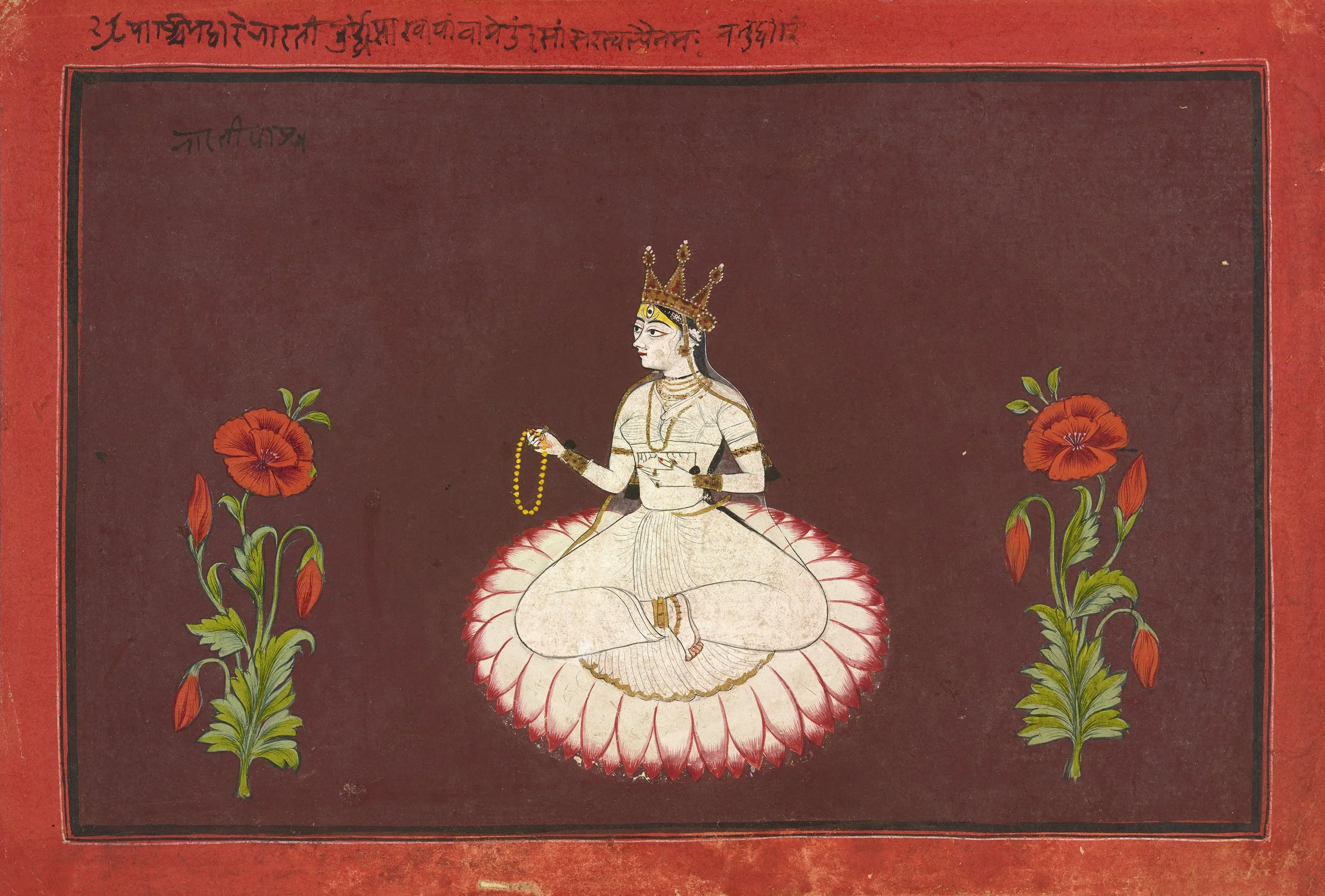
Much later, I found these age-old and helpful tenets embodied in the figure of the Indian goddess of knowledge and the arts, Saraswati: the Goddess of Speech. Here, in her simplest form, she is shown in white, denoting purity, and seated on a white lotus, the symbol of supreme reality. In her left hand she holds scripture – spiritual knowledge. In her right hand, a string of mala beads alludes to discipline, and the capacity for mature reflection. So insight flows through the prepared mind, and becomes (here, in a vibrant red) the flowering of literature and the arts.
And for those who need to know, ‘How is this of ultimate importance?’ – the iconography conveys a further promise. That under the auspices of Saraswati, the well-integrated person – open to inner growth – is one upon whom the liberating knowledge will not be lost.
Saraswati, ca. 1680-1700. Attributed to Wajid. Sawar, Rajasthan state, India. Opaque watercolour and gold on paper. 6 1/4 x 9 5/8 inches. Courtesy National Museum of Asian Art, Smithsonian. CC0.